

 Jill-Elizabeth Facebook Group
 Jill-Elizabeth LinkedIn


 About the Book
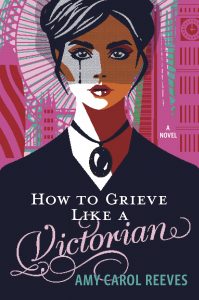 Katherine Center meets REALLY GOOD, ACTUALLY in a clever and poignant novel about an English Professor who grieves the sudden loss of her husband the Victorian way, by wearing widow’s weeds and escaping to London, where she unexpectedly discovers there’s still love, life, and burlesque to be had.
Dr. Lizzie Wells, a professor of British Literature and bestselling author, is grieving her husband the Victorian way. She keeps a lock of his hair in a choker around her neck and dons widows weeds–and notifies her colleagues and students that she will accept only paper letters instead of email.
But then she’s offered a trip to London for escape and healing, where she befriends fellow bestselling novelist AD Hemmings. Rakish and handsome, Hemmings pushes her out of her comfort zone. She attends a Victorian-style séance, gets pulled onstage at a burlesque bar, and sight-sees with her young son.
All the while, back in South Carolina, her late husband’s best friend and lawyer, Henry, peels back the layers of a family secret her mother-in-law is desperate to keep hidden. Cross-Atlantic ‘family business’ updates turn into regular FaceTime hangouts and their friendship evolves into something more. Lizzie fears she’s falling in love with him…
Struggling with conflicting feelings, Lizzie travels to Brontë country where in the windswept moors she comes to peace with grief, joy, and all the in-betweens.
Think: If Emily Henry wrote about a young widow in the vein of Really Good, Actually (irreverent, hot-mess heroine) and Lessons in Chemistry (female academic thrust into a commercial space; struggling as a single mom) with a warm-blanket romantic HEA, and loads of snark.
My Review
I liked this one a lot! While I am not a widow, thank goodness, my best friend is – and her husband also died unexpectedly and way too early. I found so much of this story to be resonant and lovely – and to feel very authentic in its recognition of all the stages and elements of grief. It’s funny and tragic and her bewilderment as she travels through her grief, while at times painful to read, was endearing and moving. The writing was lovely and perfectly suited to the story.
There was snark and wit and thoughtfulness sprinkled in with personal growth and the recognition that it is ok to move forward and that love lasts forever. It was a lovely story and one I will recommend broadly – starting with my friend…
Thanks to NetGalley and the publisher for my obligation-free review copy.
The Excerpt
OUT OF OFFICE REPLY—
Thank you for contacting me. However, for an undetermined time period, I will only be corresponding through letters. (Yes, the kind with paper.) Thank you for understanding.
Dr. Lizzie Wells
Professor of Victorian Literature—Willoughby College
Author of The Heathcliff Saga
she/her
After typing the message, I drum my fingers on my desk, contemplating the elegant stack of black-and-gold-rimmed stationery pages and envelopes in front of me. They seem appropriate for a recent widow like me, and I’m grateful for the niche Etsy shop specializing in antique stationery.
No more emails.
The thought of not reading or answering campus emails from hateful asshats like Bill Rhodes, chair of philosophy, feels like a giant fucking albatross has slid from my shoulders, feathers cluttering the floor of my coffee-stained office carpet.
Since Philip’s sudden death last month, I’ve learned I don’t have much headspace other than to parent and grieve. And I’ve barely time to parent. Heathcliff ate a Pop-Tart for breakfast this morning. A chocolate Pop-Tart, not even a fruit one. I couldn’t summon the energy to cook his regular oatmeal.
What am I going to do?
I look up at the signed Heathcliff Saga movie poster on the wall behind my desk and stare into the glassy blue eyes of teen heartthrob Everett Dane. He sneers rakishly, dark hair tousled over his forehead, rumpled shirtsleeves open to reveal the top of his Greek-god chest. He played the role well.
When Hollywood optioned film rights for my Twilight-y young adult version of Wuthering Heights—written during sleepless nights breastfeeding Heathcliff—Philip had been so proud. He took me out to a too-expensive restaurant, the kind where the servers wear crisp, ironed white dress shirts and say ridiculous things like the wine has “hints of leather and tobacco.” We split a bottle of cabernet over a large platter of roasted duck and asparagus. We even splurged on the overpriced cranberry tartlets; the cranberries, of course, were “raised in organic, sun-kissed hills near Asheville.” After dinner, we walked through a nearby pocket park. The evening sky glowed rose-hued beyond the sprawling Carolina oaks; Philip skillfully skipped rocks across a tiny, landscaped pond as we talked about a future where we could pay off student loans and take our long-postponed trip to Paris.
My email dings, and I jump, blinking away tears.
Against my better judgment, I check the message.
Ugh.
Brad McGregor.
Hey Miss Wells,
I’m really struggling with P and P. I mean I thought this chick lit was like more straightforward. But geez . . . why do they have to write so many letters? Can I like have extra credit or something if I don’t pass the Final?
Thks
B
My blood pressure rises a little bit every time I have to deal with Brad McGregor. The dean’s son needs one more English credit to graduate on time, so he enrolled in my spring Jane Austen seminar because it was the only literature class over before his “epic” Cancún vacation funded by his dad’s bloated administrative salary. His sense of entitlement has no end. He makes little effort to disguise his distaste for my class. He addresses me as “Miss” instead of “Dr.” And last, but not least, he’s Willoughby College’s most notorious man-slut; last year he cheated on one of my brightest students, Kayla, with her dorm RA. (Kayla sobbed during my office hours after she found out.)
I log out of my email, close my laptop, pull out one of my new stationery pages and a black fountain pen, and begin a furious response to Brad. A soft rap on my door, and my department chair, Patrick, enters, steam wafting from the top of his Edgar Allan Poe mug.
“Letters only?”
“This first one is going to Brad McGregor.”
“He’s the worst.” Patrick groans and takes a sip of coffee as he slumps in the worn leather armchair opposite my desk. “I had him in American lit last semester. He came to class smelling like weed, called Edith Wharton a frigid old spinster, and I’m pretty sure he slept with my TA.”
I see red as I stare down at my angry letter.
Patrick’s quiet. Although my age, thirty-nine, he sports a graying beard. He strokes it for a few seconds as he considers me worriedly. He’s trying not to look at my new black blouse with ruffled wrist sleeves and black pencil skirt. I might have gone on a widow shopping spree for black clothes in the days after Philip’s death. Patrick doesn’t need to know about the small silver bird keepsake urn containing Philip’s ashes in my leather satchel. That might make me too peculiar.
He clears his throat awkwardly and gazes into his coffee.
“You doing okay, Lizzie? I mean . . . I know you’re just back from leave, but you can take more time . . .” I wave my hand dismissively. “Everything will be worse if I don’t work. It will be all-day pajamas, and tears, and bingeing Outlander episodes.”
“Well, if there’s anything I can do for you—watch Heathcliff, send takeout . . . If there’s anything I can do to lighten your load, just let me know. I’ve already taken you off the Curriculum Management Committee and the Committee Oversight Committee.”
“Thanks,” I mutter, bewildered, as always, at how my studies of Brontë and Dickens novels prepared me for such gripping daily tasks.
I shift the topic away from me and my ongoing sadness. “Did you have your meeting with the provost today?”
He gives me the dismal summary of this month’s meeting. Each monthly provost report becomes a little more doomsday than the one before, and the jumpy junior faculty start sending out résumés to community colleges and local high schools. In our department, we just lost a fairly new full-time hire to a neighboring new technical school. (Teaching business writing is more lucrative . . . she’d said. I had no counterargument.) Now the tiny English department is just me, Patrick, a small army of adjuncts, and our MAGA-supporting administrative assistant, Sandra. (Every time I pass her desk, I try not to look at the framed illustration of Jesus sitting on a bench by the White House.)
“But it looks like Willoughby will stay open for at least another year?” I ask.
He shrugs. “Let’s just say I’m keeping my résumé updated.” He glances up at Everett Dane’s searing blue eyes. “You, on the other hand, will have plenty of options should the ship sink.”
It’s true. Although The Heathcliff Saga hadn’t exactly made me rich, as the only faculty member to appear in People magazine, I’m a reluctant darling to a struggling institution. And plenty of other schools will take me if we close.
After he leaves, I finish penning my letter to Brad. I worry it’s a bit too harsh, so I slip it into my bag. I can always revise later.
I take a late lunch outside, numb after the latest Fiscal Oversight Committee meeting, where the provost announced proudly that she was siphoning off 90 percent of the humanities department budgets for an Admissions Advancement Task Force. Her lipstick-rimmed Cheshire-cat grin stretched wider, looking directly at me as she said it. Everyone waited breathlessly for me, the committee chair, to retort. Instead, in front of all thirty faculty and ten administrators, I pulled my favorite lavender-scented ChapStick from my sweater pocket next to Philip’s miniature keepsake bird urn. I applied it thoroughly and carefully amid the silence, snapped the cap back on, and said nothing just to show how few fucks I give anymore.
Alone, in the campus garden, I sit on a mossy stone bench in the shade of an oak. Bees hum loudly through the blue flag irises and bulblike pink blossoms of the small magnolia near me. I open my Tupperware dish of macaroni casserole. As a Midwest transplant, I’m always amazed at Southerners’ culinary zest for the grieving. I have about twelve macaroni casseroles and five lasagnas in my freezer. Heathcliff can’t digest dairy, so I’ll be eating these myself in the forthcoming weeks.
Even in the shade, my armpits sweat in this Carolina May heat. Still, I’d choose this over my windowless office any day. Through the garden gate, I see Bill Rhodes storming into the administration building—no doubt to unload on the president about me and Patrick. I can’t care. No one will ever option film rights for his latest book—Metaphysical Intellectualism in Neoclassical England.
Last fall was such a bright star for me when The Heathcliff Saga film premiered and my book spent several weeks on the New York Times bestseller list. Writing that book six years ago, postpartum, kept me sane. I gave everyone A’s that semester. With the hormone shifts, lack of sleep each night and an insatiable Heathcliff hanging off my breast, I’d escape into my alternative Wuthering Heights world. In my book, Emily Brontë’s love-triangled teenagers learn that Heathcliff inherited warlock powers from a distant Yorkshire ancestor. My Linwood is less milquetoast than the original character. He bastardizes ancient Fae supernatural powers from the moorlands and starts a spell war with Heathcliff. Cathy, caught in the middle, asks Nelly Dean to train her in the supernatural arts. She teams up with Heathcliff, helping him purge Linwood’s magical darkness for good. There’s lots of teen angst, desperate kissing, and disengaged parents. The adults churn butter and argue with no idea their teens could destroy Great Britain with their dark fairy arts war.
My literary agent, Sarah, took me on and sold the book in two days. I loved my editor, my only complaint being that he wanted to change the title from The Cathy Saga to The Heathcliff Saga. I groused. After all, I wanted my heroine to be the book’s star. But he said “Cathy” wasn’t distinct enough—it sounded like the comic-strip character—and he wanted my Heathcliff to be the new Edward Cullen.
Then I thought about my forthcoming advance check and gave in. The timing couldn’t have been better. Over the next few years, film rights sold, then foreign rights in Spain, Germany, and Japan. By the time the movie came out last year and I had my red-carpet moment, Willoughby’s president offered me immediate tenure and a promotion.
Putting the lid on my Tupperware, I scroll fondly through my Instagram page. Thanks to the movie, I have about 100,000 followers, and I pick up a few hundred more every time one of the stars tags me. My last Instagram post was a repost of Everett Dane’s pic of him hugging me at the premier after-party: “Love this woman! Brainiest person I’ve ever known.”
I’m suddenly back in that moment, slight champagne buzz, surrounded by the glamorous and Botoxed. I wore a rented teal Vera Wang and teetered on strappy gold Jimmy Choos; I was in this young British heartthrob’s arms, and yet I locked eyes with Philip, standing just beyond the photo’s edge. With his soft, sandy blond hair and glasses, my shy lawyer husband never seemed more mine than in that moment. He wasn’t a crier—ever. It’s a weird Southern guy thing. But his eyes shined happy tears. There was no professional or personal jealousy there; it was pure celebration of me, of us—of how profoundly lucky we were to have each other and that moment.
My phone dings.
Mirabel: Hi Elizabeth, you’ve been on my mind so much. Lunch tomorrow? My treat☺
I groan.
My Steel Magnolia, passive-aggressivemother-in-law has been trying to get me out to lunch since the funeral. Lunch. I stare down at my Tupperware of mostly uneaten macaroni. Apparently, the grieving have to eat.
There’s been a persistency in her texts.
Something’s off.
And I just can’t even with her because it will make me think of that night—Philip
was leaving her house when his car ran off the road.
There was the call from him, just before the accident. The voicemail he left: My god, Lizzie, we have to talk.
The spongy casserole feels like a lump in my stomach. I’d rather face ten meetings with Bill Rhodes than think about that night and all the factors involved: rain, lightning, deer, emotional shock, the million random sparks that might have made Philip’s 2017 black Camry slide off the road between Summerville and our home in Columbia, South Carolina. But painful as it might be, I need to know what happened at her home to upset Philip. Mirabel’s been acting cagey, and I’ll have to tread carefully.
My mother-in-law loves her azalea gardens, her large home, the Methodist Women’s League. She likes lipsticks and Talbots dresses.
Unfortunately, the one thing Mirabel doesn’t like (besides me) is the truth.
 Excerpted from How to Grieve Like a Victorian by Amy Carol Reeves. © 2025 by Amy Carol Reeves, used with permission from Canary Street Press, an imprint of HarperCollins.
About the Author
AMY CAROL REEVES has a PhD in nineteenth-century British literature and finds joy in teaching classes and writing. She’s published several academic articles as well as a young adult book trilogy about the Jack the Ripper murders in Victorian London. She lives in a quirky old house in Indianapolis with her three children. www.amycarolreeves.com
Find Amy Carol Reeves online at:
- Website: https://www.amycarolreeves.com/
- Instagram: https://www.instagram.com/amycarolreeves/
- Facebook: https://www.facebook.com/AmyCarolReeves?ref_type=bookmark
- Goodreads: https://www.goodreads.com/author/show/4968653.Amy_Carol_Reeves?from_search=true&from_srp=true
Author photo credit: Emily Persic

Leave a Reply